From SaaS to GAAS: Why Agentic AI Will Redefine Business Operations |

For years, technology companies have competed by building better software.
The formula was simple: create a tool, charge a monthly subscription and help customers become more productive. This model, known as Software as a Service (SaaS), became the foundation of modern business. Platforms like Salesforce, HubSpot, Slack, Asana and Notion reshaped how organizations operate.
But according to NVIDIA CEO Jensen Huang, we are entering a new chapter.
A chapter where businesses don’t just buy software tools.
They hire digital workers.
The transition from SaaS to GAAS (Agentic as a Service) represents far more than another technology trend. It signals a fundamental change in how work gets done, how companies create value and how competitive advantages are built.
For business leaders, agency owners and entrepreneurs, this shift deserves serious attention.
To understand where we’re headed, it’s important to understand where we’ve been.
The SaaS revolution changed everything about business technology. Instead of installing software on company servers, organizations could access powerful applications through the cloud for a monthly fee.
This model unlocked incredible growth.
Businesses gained access to:
Yet despite all the innovation, one thing remained constant:
Humans still had to do the work.
The software provided functionality, but employees provided the labor.
A CRM could organize customer data, but salespeople still needed to update records.
A marketing platform could send emails, but marketers still needed to create campaigns.
A project management system could track tasks, but managers still needed to coordinate execution.
The software improved productivity, but it didn’t replace the workflow itself.
Agentic AI changes the equation.
Instead of simply providing tools, AI agents can perform tasks, make decisions and complete workflows with minimal human intervention.
Think about the difference.
Traditional software might give you a dashboard for managing leads.
An AI agent can:
The user isn’t interacting with software.
They’re receiving outcomes.
This distinction is critical because it shifts the focus from technology capabilities to business results.
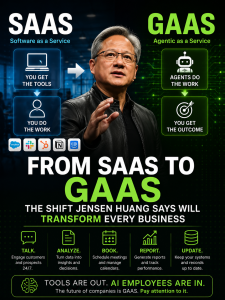
GAAS, or Agentic as a Service, is the business model emerging from this new reality.
Instead of paying for access to software features, companies pay for AI agents that complete specific jobs.
In the SaaS model, businesses rent tools.
In the GAAS model, businesses rent workers.
Of course, these workers are digital rather than human.
The value proposition changes dramatically.
“Here’s the software. Now go do the work.”
“Tell us the outcome you want. We’ll deliver it.”
This shift mirrors a broader trend already happening across industries.
Businesses increasingly care less about managing technology and more about achieving results.
The organizations that understand this distinction early may gain a significant competitive advantage.
One of the most important strategic changes happening right now is the move from feature-based thinking to outcome-based thinking.
Historically, software vendors competed by offering:
In an Agentic AI world, those factors become less important.
The key question becomes:
Can the agent deliver the desired business outcome?
A CEO doesn’t care whether a lead generation system has twenty features or two hundred.
They care about pipeline growth.
A marketing director doesn’t care how many automation workflows exist behind the scenes.
They care about qualified opportunities.
An operations leader doesn’t care how sophisticated the dashboard looks.
They care about efficiency and profitability.
The companies that focus on delivering outcomes rather than software functionality are likely to define the next generation of technology businesses.
Every significant technological shift forces organizations to reevaluate existing assumptions.
The rise of Agentic AI is no different.
Business leaders should begin asking new questions.
Instead of asking:
“What software should we buy?”
They should ask:
“What outcomes are we trying to achieve?”
And more importantly:
“Can AI agents deliver those outcomes faster, cheaper, or more effectively?”
This mindset shift has implications across nearly every department.
AI agents can:
AI agents can:
AI agents can:
AI agents can:
Organizations that identify opportunities for agent-driven outcomes will likely gain operational advantages over competitors who remain dependent on traditional workflows.
For agency owners, this transition creates one of the biggest opportunities in decades.
Many agencies currently sell services based on hours, deliverables, or access to expertise.
Agentic AI introduces a new model.
Instead of selling effort, agencies can increasingly sell outcomes.
Consider the difference.
A traditional agency might offer:
An AI-powered agency could offer:
Clients care about results.
Agentic systems create new ways to deliver those results at scale.
The agencies that embrace this shift won’t simply use AI internally. They’ll redesign their entire value proposition around outcome delivery.
One of the most powerful insights from Jensen Huang’s comments is the distinction between AI tools and AI employees.
Many businesses today are focused on building AI-powered software.
That approach still has value.
However, the bigger opportunity may be building AI systems that function like employees.
Rather than creating a chatbot feature, create an AI sales representative.
Rather than creating an analytics dashboard, create an AI business analyst.
Rather than building another automation platform, create an AI operations manager.
This perspective changes how products are designed, marketed, and sold.
Businesses don’t ultimately want more tools.
They want problems solved.
The closer an AI solution gets to delivering complete outcomes, the more valuable it becomes.
History offers valuable perspective.
When the internet emerged, many organizations underestimated its impact.
Some viewed websites as optional.
Others believed digital commerce would remain niche.
The businesses that adapted early created entirely new industries.
Amazon, Google, Shopify, Salesforce, and countless others emerged because they recognized a structural shift before it became obvious.
The same pattern is unfolding with Agentic AI.
The technology itself is important.
But the real opportunity lies in understanding how business models change when technology evolves.
GAAS isn’t just about smarter software.
It’s about redefining how value is delivered.
Every major transformation creates winners and losers.
The greatest risk for many organizations isn’t moving too quickly.
It’s assuming they have more time than they actually do.
AI adoption continues to accelerate across industries.
Enterprise organizations are already experimenting with AI agents for:
As capabilities improve, expectations will shift.
Customers will begin expecting outcomes, not software access.
Businesses that prepare now will be better positioned to meet those expectations.
Those who wait until the transition becomes obvious may find themselves competing in a market that has already changed.
The transition from SaaS to GAAS represents a profound change in how businesses think about technology.
For decades, software helped people work more efficiently.
Now, software is evolving into something entirely different.
It is becoming a workforce.
Agentic AI won’t eliminate the need for human creativity, leadership, or strategic thinking. Instead, it will automate an increasing number of repetitive and operational tasks that consume valuable time and resources.
The winners in this new era won’t necessarily be the companies with the most advanced technology.
They’ll be the companies that best understand how to deliver outcomes.
That distinction may define the next generation of market leaders.
Read more about our AI Services and Products
GAAS stands for Agentic as a Service. It refers to a business model where organizations pay for AI agents that perform tasks and deliver outcomes rather than simply providing access to software tools.
SaaS provides software features that require human effort to generate results. GAAS provides AI agents that complete workflows and deliver outcomes with minimal human involvement.
AI agents are autonomous systems capable of performing tasks, making decisions, interacting with software and completing business processes to achieve specific goals.
Agentic AI is more likely to automate repetitive, administrative, and process-driven work. Human roles focused on strategy, creativity, relationship-building and leadership will continue to play a critical role.
Technology shifts often reward early adopters. Organizations that learn how to leverage Agentic AI today may establish competitive advantages before widespread adoption occurs.
Jensen Huang’s observations aren’t merely predictions about the future – they’re reflections of changes already taking place inside some of the world’s largest organizations.
The question is no longer whether AI will transform business operations.
The question is how quickly businesses will adapt to a world where outcomes matter more than tools.
As the shift from SaaS to GAAS accelerates, forward-thinking leaders have an opportunity to rethink how work gets done, how value is created, and how growth is achieved in the age of Agentic AI.
The future may not belong to companies with the best software. It may belong to companies with the best AI workforce.
Contact Us:
www.modernwebpresence.com
Read more about our AI Services